The Carbon Border Adjustment Mechanism (CBAM) is an EU initiative aimed at reducing global carbon emissions by placing a carbon price on imports in carbon-intensive sectors like cement, steel, aluminum, fertilizers, hydrogen, and electricity.
CBAM Calculation
a) Free CBAM estimator
What makes it unique:
- 120+ Country coverage: Pre-loaded country-specific default emission values and carbon pricing data, so you don't have to research each market individually.
- Quarterly projection: Built-in CBAM phase-in factors automatically calculate your escalating carbon costs as free allowances decrease year over year.
- Smart fallback logic: When country-specific data isn't available, the calculator seamlessly applies EU fallback values to ensure no gaps in your compliance estimates.
- 1,800+ CN codes: Comprehensive product coverage with automatic benchmark matching based on production routes.
|
BearingPoint's CBAM Estimator supports organizations in assessing their potential CBAM impact. By entering the country of production, product CN code, and import quantity, users receive an indicative estimate of potential CBAM costs, helping them identify areas that may require further analysis.
Read our terms and conditions before using the calculator. |

Navigate EU's Carbon Border Adjustment Mechanism with confidence. Our comprehensive CBAM Calculator instantly estimates your carbon costs for imports from 120+ countries, covering all 6 CBAM sectors - cement, iron & steel, aluminium, hydrogen, fertilizers, and electricity. From default emission values, benchmarks and quarterly CBAM price - everything you need is in one powerful tool.
b) Integrated CBAM solutions, including declaration
A CBAM declaration contains more than 200 data points and requires data from material master, purchasing, customs, transport and finance. Integrated CBAM solutions consume data from the corresponding IT-Systems in an automated way. In addition they support declarations to the EU as well as building accruals to pay required CO2 certificates in upcoming periods.
Benefits and Use Case
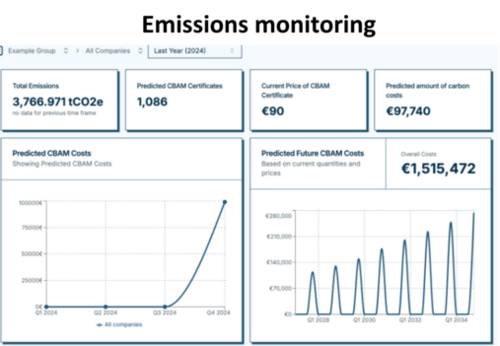
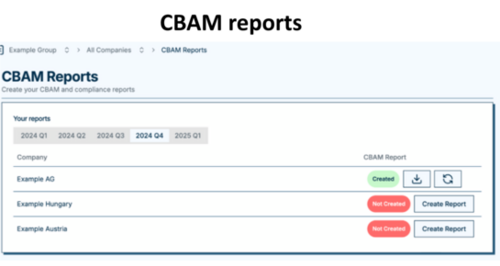
A.) Professional CBAM software solutions automatically collects and calculates emissions for all your CBAM-imported goods across multiple subsidiaries and it generates CBAM-compliant reports with a single click.
- Up to 90%-time savings in report generation – automates complex tasks like emission calculation, data aggregation, and data formatting.
- Automated data collection & one-click reporting.
- Reliable emissions data from global suppliers – it offers end-to-end support for collecting accurate emissions data directly from non-EU suppliers, incl. built-in guidance.
- Guaranteed compliance with EU CBAM regulations – it ensures 100% adherence to regulatory requirements.
- Secure & centralized data management – all data is safely secured on EU servers protected by industry-leading encryption standards and full GDPR compliance.
If you look for an integrated CBAM solution including declaration we can help as well - just reach out to us.
B.) Delivering a complete CBAM Journey: From CBAM compliance to strategic value
We support organisations across the full EU Carbon Border Adjustment Mechanism (CBAM) lifecycle, from early CBAM compliance readiness through to long‑term strategic decision‑making. By combining deep regulatory expertise with operational, sustainability, and financial capabilities, we help organisations prepare for the definitive CBAM period starting with imports from 1 January 2026, and for the associated financial and governance impacts beyond.
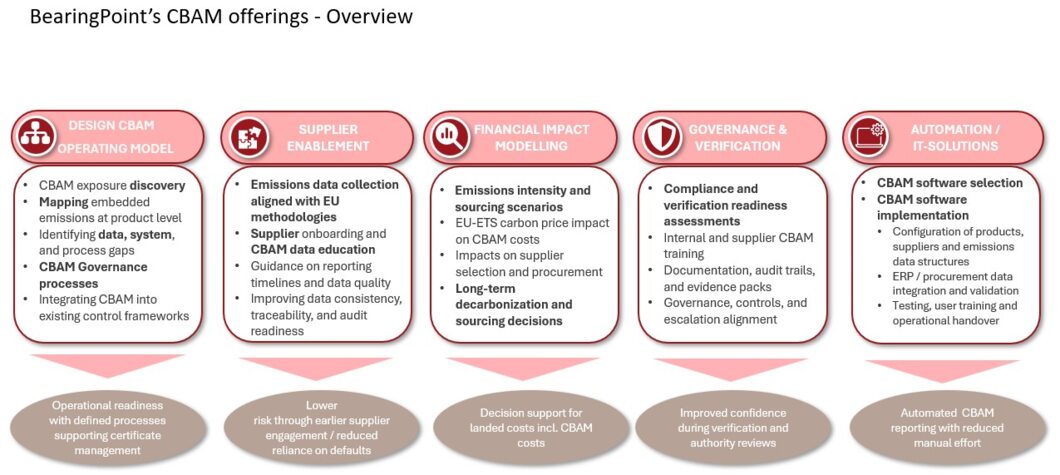
Designing a robust CBAM operating model
A strong CBAM operating is essential to ensure compliant, auditable, and scalable CBAM implementation. We support organisations in designing and embedding CBAM processes across customs, procurement, sustainability, and finance, aligned with CBAM legal requirements and EU regulatory expectations.
Our support includes:
- CBAM exposure assessment across imported CBAM goods.
- Mapping product‑level embedded emissions and associated CBAM carbon exposure.
- Defining clear roles, responsibilities, and governance across CBAM‑relevant functions.
- Identifying data, system, and process gaps affecting CBAM reporting and controls.
- Integrating CBAM reporting and record‑keeping into existing operating and internal control frameworks.
Your benefits:
- Confidence that your organisation is ready for ongoing CBAM reporting obligations
- Operational readiness for CBAM compliance in the definitive period
- Defined processes supporting CBAM certificate management
- Improved visibility of CBAM‑related financial and cash‑flow impact
- Reduced risk of compliance issues as CBAM requirements evolves
Supplier enablement and CBAM data readiness
Effective CBAM compliance depends on supplier readiness and the availability of reliable embedded emissions data from non‑EU installations. We support supplier engagement under CBAM through structured enablement approaches that help suppliers understand their data, documentation, and methodological obligations under the Carbon Border Adjustment Mechanism.
Our supplier enablement services include:
- Practical CBAM emissions data collection templates aligned with EU methodologies
- Supplier onboarding and education on CBAM data and documentation requirements
- Clear guidance on reporting timelines, data quality expectations, and supporting evidence
- Support to improve data consistency, traceability, and audit readiness
Your benefits:
- Lower CBAM reporting risk through earlier supplier engagement and more consistent emissions data inputs
- Reduced reliance on conservative default values, helping limit unnecessary CBAM certificate costs where actual data can be used
- Improved data completeness and traceability, supporting more robust CBAM reports
- Less painful authority reviews and accredited CBAM verifiers through better‑prepared supplier data, supporting you at every step
- More predictable compliance outcomes as CBAM enforcement and scrutiny increase in the definitive period
CBAM verification and governance readiness
We prepare organisations for CBAM verification by translating regulatory requirements into clear, auditable processes and governance structures. Our support focuses on strengthening internal controls, documentation, and organisational readiness in line with EU CBAM verification expectations.
This includes:
- CBAM compliance and verification readiness assessments
- Internal and supplier‑facing CBAM training
- Design of documentation, audit trails, and evidence packs
- Alignment of governance, controls, and escalation processes
Your benefits:
- Greater confidence during CBAM verification and authority reviews through strong governance and well-prepared documentation
- Lower risk of misstatements and re‑assessments, limiting reliance on conservative default values
- Stronger internal governance and control over CBAM obligations, even as requirements evolve
- Faster and more confident responses to verifier or authority questions, with clear audit trails and escalation paths
- Reduced compliance disruption by identifying and addressing issues before they become enforcement findings and penalties
CBAM financial impact and scenario modelling
Understanding future CBAM financial impact is critical, particularly ahead of the first CBAM certificate purchase and surrender cycle starting in 2027 for 2026 imports. We support CBAM financial impact assessments and scenario modelling to help organisations anticipate cost impact under different regulatory and operational assumptions.
Our modelling covers:
- Emissions‑intensity and sourcing scenarios (actual vs default values)
- Impact of EU-ETS carbon price levels on CBAM costs
- Impacts on supplier selection and procurement strategies
- Long‑term investment, decarbonisation, and sourcing decisions
Your benefits:
- More informed procurement decisions by understanding how sourcing choices and emissions intensity values translate into future CBAM costs
- Clear visibility on CBAM cost drivers under different scenarios, including actual versus default emissions and EU ETS price movements
- Better‑informed supplier engagement strategies, supported by quantified cost implications of emissions performance and data availability
- Stronger inputs into capital allocation and decarbonisation levers, by linking CBAM cost exposure to long‑term investment and sourcing options
- Greater confidence in planning for the first CBAM certificate purchase and surrender cycle, aligned with the definitive‑period rules starting with 2026 imports and 2027 compliance
CBAM Automation / IT-Solutions
CBAM software solutions improve financial, operational, and strategic outcomes by making carbon costs visible and actionable.
This includes:
- CBAM software selection
- CBAM software implementation
- Configuration of products, suppliers and emissions data structures
- ERP / procurement data integration and validation
- Testing, user training and operational handover
Benefits
- End-to-end integration
- Less manual effort
- Reduced risks
- Audit ready
Frequently asked questions
-
What is CBAM and who does it apply to?
CBAM stands for carbon border adjustment mechanism. It applies to EU importers of carbon-intensive goods such as steel, aluminum, cement, fertilizers, hydrogen, and electricity.
-
What kind of data is required for CBAM compliance?
You’ll need accurate emissions data (typically scope 1 and 2) for CBAM-covered goods from your non-EU suppliers, including material-specific CO₂ values.
-
Is this solution GDPR-compliant?
Yes. All emissions and supplier data are securely stored on EU servers with industry-standard encryption and GDPR compliance.