As sustainability becomes a core business imperative, organizations need more than high-level estimates of their environmental impact - they require precise, auditable data embedded in everyday operations. Transactional carbon accounting addresses this need by capturing emissions at the same level of detail as financial transactions.

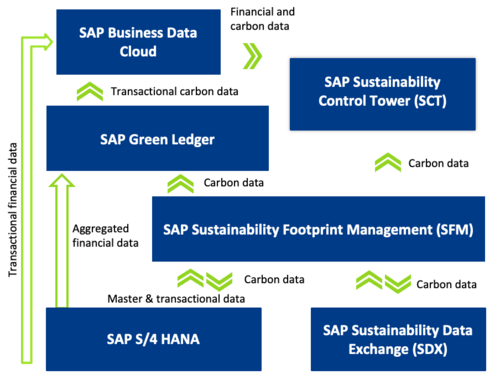
SAP’s sustainability portfolio provides an integrated approach to achieve this. Together, the SAP solutions Green Ledger, Sustainability Footprint Management, Sustainability Data Exchange and Sustainability Control Tower create a closed loop from data collection to reporting, turning sustainability into a measurable, actionable part of business processes. This blog post offers a step-by-step flow on how to put transactional carbon accounting into practice using SAP sustainability solutions.

If you want to learn more about the concept and its strategic importance, read our white paper:

  • Saving carbon is saving money 1.48 MB Download

Step #1

Supplier Data Collection (SAP Sustainability Data Exchange) 

Accurate transactional carbon accounting depends on obtaining precise carbon data, rather than relying on generic assumptions or industry averages. A key component is acquiring footprints directly from suppliers, such as for embedded emissions of purchased products – Product Carbon Footprints (PCFs). These emission factors are often shared through Excel sheets or PDFs sent by email – a process that can lead to errors, lacks standardization, and fails to keep data centralized. SAP Sustainability Data Exchange provides a solution by enabling the exchange of standardized, industry-aligned carbon data—such as WBCSD PACT—while delivering auditability through streamlined, end-to-end workflows. 
Step #2

Footprint Calculation (SAP Sustainability Footprint Management) 

After carbon data is gathered with SAP Sustainability Data Exchange, it is automatically integrated into SAP Sustainability Footprint Management (SFM). SFM consolidates supplier footprints with internal operational data—including master and transactional data from your ERP system—as well as information on energy consumption and transportation. For cases where emission factors are unavailable, an AI-powered feature streamlines the mapping of emission factors, significantly reducing manual effort. 

Once all relevant data is compiled, the system performs footprint calculations for both final and intermediate products, production processes, resources, and other components. The resulting level of detail is crucial for subsequent steps, when utilizing SAP Green Ledger. 

Step #3

Integrating carbon into transactional accounting (SAP Green Ledger) 

SAP Green Ledger integrates carbon footprint data from SAP Sustainability Footprint Management directly into transactional accounting by creating corresponding carbon entries alongside financial postings in SAP S/4HANA (e.g., goods receipts, energy invoices, supplier invoices), and serves as the central hub for carbon accounting at the transaction level. It aligns carbon emissions with financial master data and applies financial accounting principles (such as double-entry and audit-ready postings) to greenhouse gas (GHG) quantities, making carbon impacts as traceable and compliant as monetary entries. 

Once carbon data is posted, Green Ledger allocates CO₂ quantities to responsible cost centers, profit centers, accounts, or other financial dimensions—enabling organizations to quantify both carbon and financial impacts across departments, locations, segments, and business units. 

Step #4

Analytics & Reporting (SAP Green Ledger, SAP Sustainability Control Tower, SAP Business Data Cloud) 

The results captured in SAP Green Ledger can be leveraged to generate internal reports and perform in-depth analyses of an organization’s carbon data. The solution provides comprehensive capabilities for data visualization, trend analysis, CO₂e flow statements, and integrated financial statements with CO₂e quantities, enabling a holistic view of environmental and financial performance. 

SAP Green Ledger also integrates with analytical platforms such as SAP Datasphere and SAP Analytics Cloud that are part of the SAP Business Data Cloud, enabling businesses to visualize, compare, and analyze carbon metrics alongside financial KPIs including revenues, margins, and intensities. This analytical integration allows organizations to move beyond compliance by supporting strategic activities like carbon budgeting, scenario simulation, and forecasting of future emissions and reduction initiatives. By ensuring that sustainability data informs both daily operations and long‑term planning, it strengthens transparency, accountability, and actionable guidance across the value chain - helping organizations manage their carbon footprint without compromising financial performance. 

The carbon and financial data can also be seamlessly integrated into the SAP Sustainability Control Tower, where it is consolidated with other ESG metrics into a central, auditable data foundation. The data is harmonized and validated to ensure consistency, enabling compliant ESG reporting aligned with CSRD and the EU Taxonomy. By centralizing sustainability data, organizations reduce manual effort, improve data quality, and streamline reporting for compliance and stakeholder transparency.  

Ready to take the next step toward transactional carbon accounting?  

Reach out to us to discuss your goals or explore how we can help you implement a robust, future‑ready carbon accounting approach tailored to your organization. 

Contact us

We use reCaptcha to secure our forms. This requires JavaScript enabled.

This submission has been blocked due to detected suspicious activity or security concerns. If you believe this is an error, please try again later or contact support for assistance.

Complete all fields marked with an asterisk

Ready to scale your carbon management?

Talk to our experts and start building a clear, compliant, and measurable sustainability strategy.