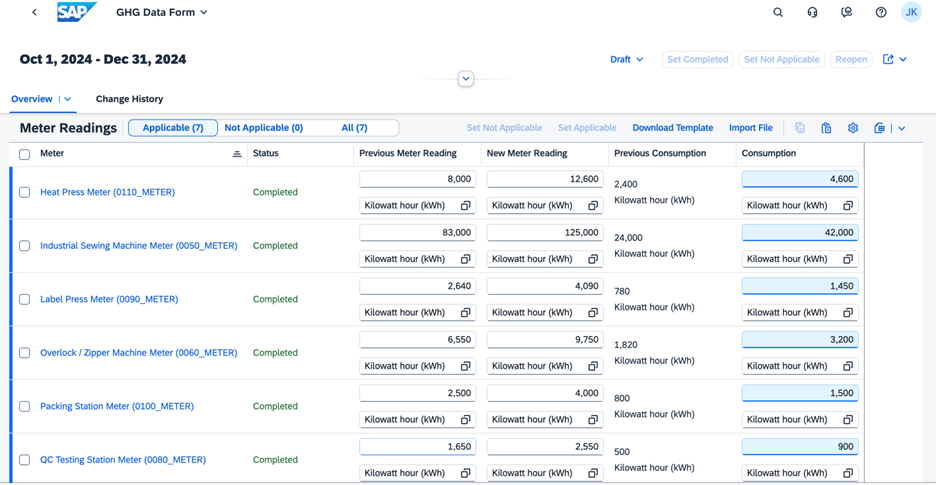
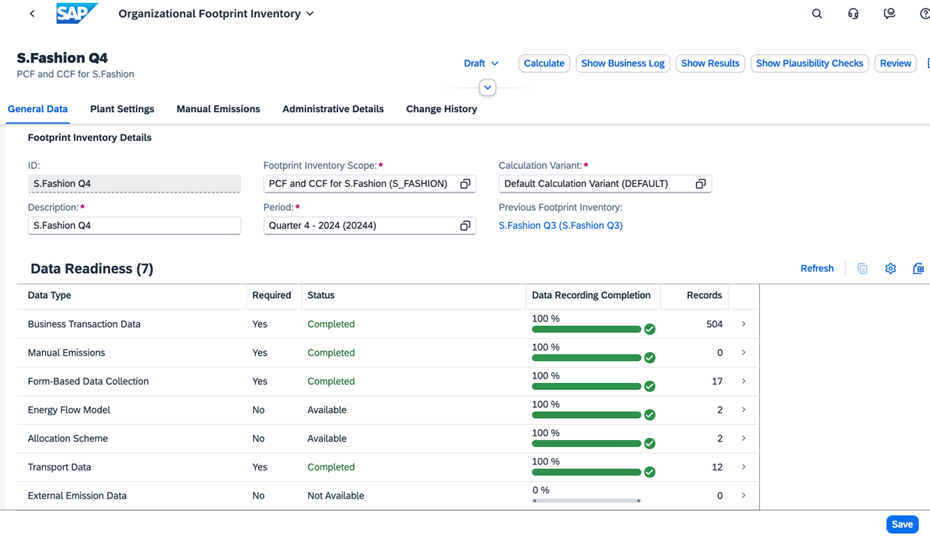
The newest SAP release addresses these issues by streamlining how energy data is handled. Meter readings and energy bills are now maintained independently from footprint inventories through GHG data forms. Ongoing energy information can be captured once using the Record GHG Data app and then applied to multiple footprint calculations, eliminating duplicate entries. This decoupling of data upkeep from individual calculation scenarios significantly lowers manual effort and ensures more consistent results.
Beyond simplification, SAP has expanded calculation options. Energy-based footprints can now be determined directly from energy sources, without the need to define an energy flow model, an especially valuable enhancement for Corporate Carbon Footprint (CCF) reporting. The Calculate Footprints app has also been refined, giving users immediate visibility of data readiness on the inventory’s opening screen, which speeds up navigation and improves overall usability.
Coordinating greenhouse gas information across numerous sites and data categories often becomes complex, particularly when large volumes of information are involved. To address this, a new bulk-upload feature has been introduced for GHG data forms. With a single, unified template, users can now import various data types—such as energy invoices, meter readings, business activities, and waste—across multiple locations through the Record GHG Data and Manage GHG Data Collections apps. Each data category is organized into its own worksheet within the template, enabling centralized handling of information and significantly reducing manual work.
Automation capabilities have also been expanded on the technical side. The GHG Data Forms API now supports mass updates and enables a seamless integration with external platforms, as well as direct connections to smart meters or IoT-enabled devices.