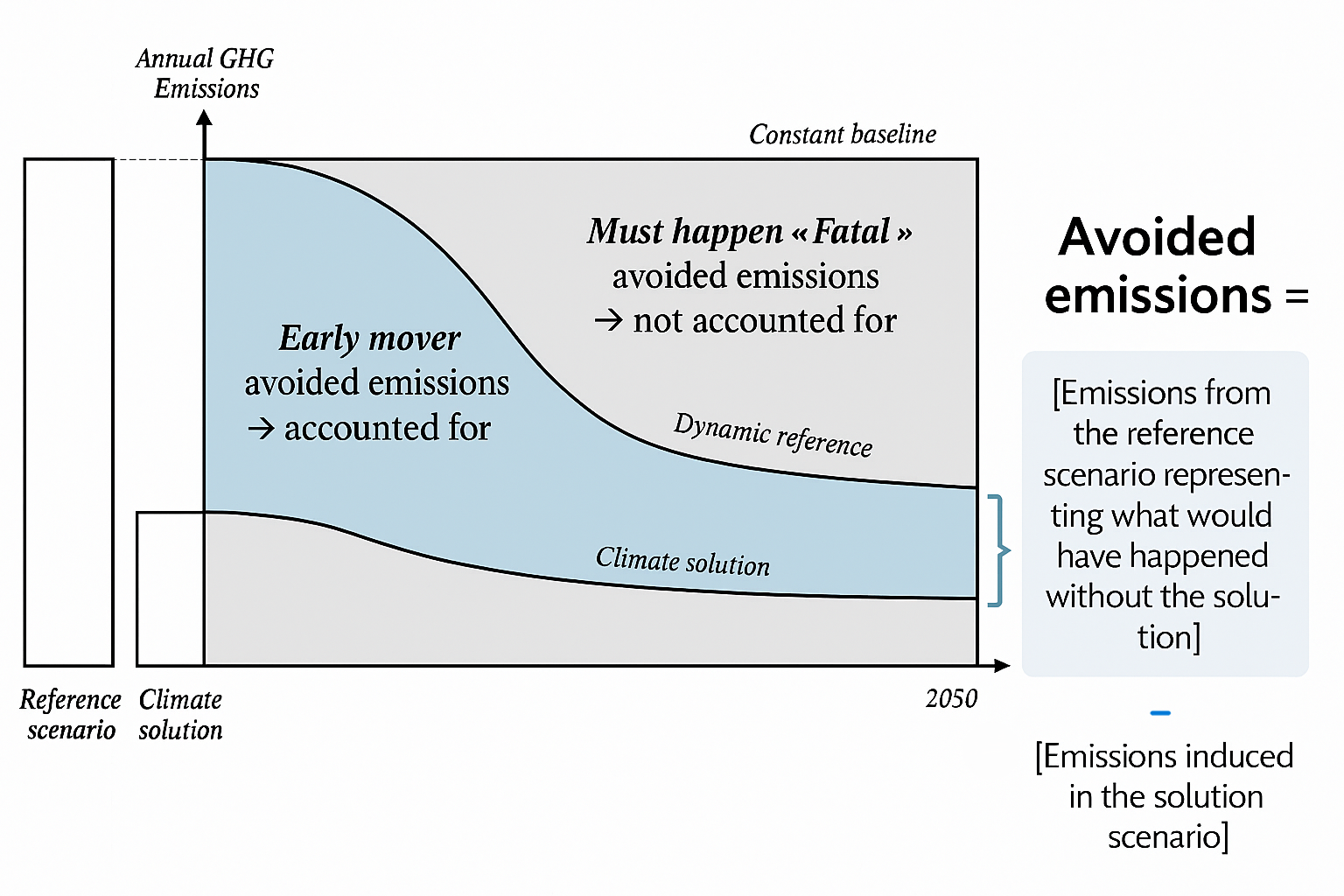
While Scope 1, 2, and 3 emissions are increasingly being tracked and reported by companies worldwide, avoided emissions – sometimes informally referred to as Scope 4 emissions - have not yet received as much recognition. Unlike the first three scopes, Scope 4 focuses on a different sustainability dimension: emissions that “determine a project's contribution to the low-carbon transition. It represents the delta of CO2e between the induced emission of a project and a reference scenario representing what would have happened without the project.”.1
There are two key perspectives; the corporate view and the financial institution view. The first can be illustrated by the example of a battery manufacturer for electromobility: their product helps to reduce the number of fossil fuel-powered vehicles on the road – emissions that don’t appear in the battery manufacturer’s carbon inventory. The battery, not yet part of the value chain, competes against a conventional car, which is a long-established component of the automotive value chain. Capturing the contribution to reduce overall emissions is the essence of avoided emissions.
Conversely, financial institutions play a crucial role in accelerating global transition. By incorporating avoided emissions metrics into sustainability-linked objectives such as green bonds or Article 9 funds, they can design tailored finance instruments that incentivize climate-positive outcomes. They also have the ability to channel capital toward transformative initiatives and businesses with strong potential for emissions reduction. Finally, they can foster corporate collaboration by advocating the expansion of solutions that actively reduce emissions across value chains.
To effectively leverage these mechanisms, it’s essential to understand the difference between reduced and avoided emissions. Reduced emissions stem from a company’s direct efforts to cut its footprint, often through an emissions reduction plan. Avoided emissions, by contrast, are based on a reference scenario in which a low-carbon scenario is compared to a more traditional scenario. Thereby, one asks the question of „What would have happened if...” 2
Building on this foundation, there are three ways for a company to contribute to carbon neutrality:
This visualisation by I Care by BearingPoint displays the latter. 3
Thereby, the GHG Protocol lays out the groundwork for avoided emissions through comparative assessments, evaluating a product or service against a baseline alternative. Taking a step further, WBCSD expands on what a “scenario” entails: a counterfactual baseline (what would emissions be without the solution?), clear boundaries for processes and transparency (which market trends should be considered?), and dynamic behavior (reflect future changes instead of remaining static). 4
The key issue is the lack of standardization and consistency. Because the robustness of avoided emissions assessments depends heavily on the availability and quality of underlying data, gaps in data integrity often lead to results that lack credibility and comparability. This highlights the need for operationalized baselines (defining the reference scenario at the solution level to reduce discrepancies among analysts modeling the same avoided emissions) and a universal tool to build consensus.
This is why I Care by BearingPoint developed a comprehensive methodology, embedded in its Avoided Emissions Platform (AEP) tool, to harmonize the calculation of avoided emissions and tackle key challenges. The approach answers fundamental questions such as:
In addition, the methodology addresses specific technical aspects, including: 1,5
Avoided emissions offer a strategic advantage for companies aiming to position themselves as climate solution providers. This includes:
The objective for companies and stakeholders going forward:
Use cases are emerging across sectors - from clean energy to digital services - showing how avoided emissions can become a key metric in climate-aligned decision-making. While many companies are still exploring their role in the transition, avoided emissions offers a forward-looking lens to measure and scale real-world climate impact, enabling to strive towards a low-carbon transition.
The above-mentioned AEP tool can be found here: AEP.