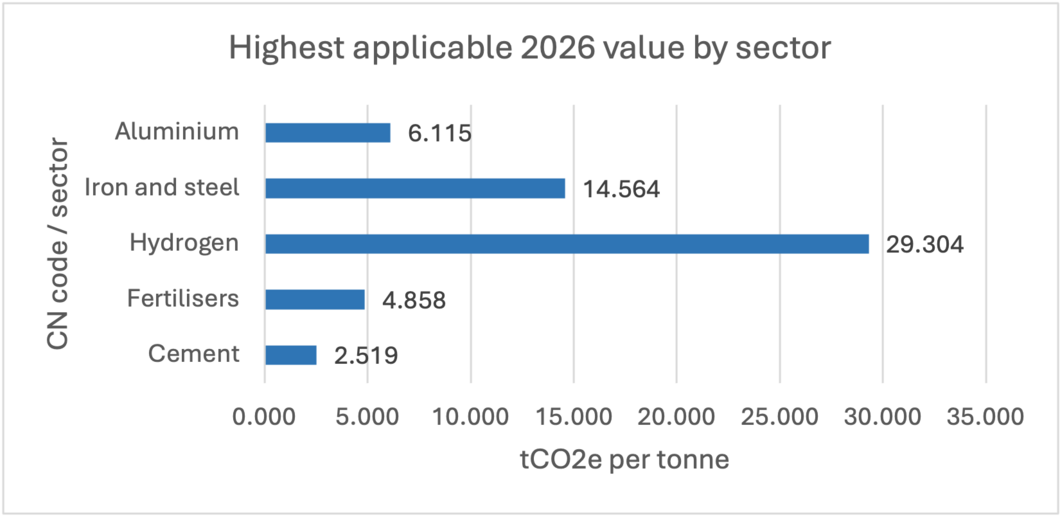
Calculation methodology is simplified
The Commission removed the pre-calculated mark-up columns that had been included for 2026, 2027 and 2028.
Instead, companies should calculate adjusted values directly from total emissions:
- Fertilisers: 1% mark-up
- Other CBAM goods using Annex I default values: 10%, 20% and 30% mark-ups depending on the applicable year.
This reduces rounding inconsistencies and aligns calculations with the legal methodology.
The biggest impacts identified
Taiwan steel corrections dominate
32 changes are linked to Taiwan, including 28 steel product defaults. Once the erroneous country values were removed, the calculations automatically shifted to fallback values.
In our test cases, the resulting default emissions values were typically 40-60% lower, creating substantial reductions in illustrative CBAM costs.
Missing country values have been restored
Several country-specific values that were omitted in the previous version have now been reinstated.
Examples include:
- Gabon (Hydrogen)
- Liberia (Hydrogen)
- Guatemala (Ferro-nickel)
- New Caledonia (Ferro-nickel)
Because the restored values are lower than the generic fallback used previously, the resulting CBAM exposure decreases significantly.
For example:
- Gabon hydrogen falls from 19.514 tCO₂e/t to 11.902 tCO₂e/t, a reduction of approximately 39%.
- Guatemala ferro-nickel falls by approximately 13%.
Angola moves in the opposite direction
Not every correction results in lower emissions.
For Angola iron ore (CN 26011200), the country-specific value was removed, meaning the calculation now uses the fallback value. Because the fallback is higher, default emissions increase.
Tunisia aluminium codes were corrected
Four Tunisia-related aluminium code corrections were introduced.
Two obsolete records were removed, while two codes received corrected values:
- 76169910 decreases significantly.
- 76169990 increases significantly.
The direction of impact therefore depends entirely on the imported product code.
Annex IV precursor values were reset
Two Annex IV aluminium precursor values were corrected.
Importantly, these values apply only when the country of production of the precursor cannot be identified. They should not be treated as a general fallback mechanism for standard imports where country information is available.